Any website or service with an API → your database
Your website, marketplace or service has an API, but nobody collects the data from it. We set ETL Sync up for that API: on schedule the program fetches the responses, splits the JSON into columns and writes them to your database — next to your 1C, ERP and spreadsheet data.
REST APIJSONMS SQLPostgreSQLBefore → after
How it works
- 1
Address and key
Which API, which methods and an access token — read-only.
- 2
We set it up
We describe the API responses: which fields go into which tables.
- 3
Your database
Your own server or cloud storage on our server.
- 4
On schedule
New records are fetched on their own — every few minutes or once a day.
What it looks like in the program
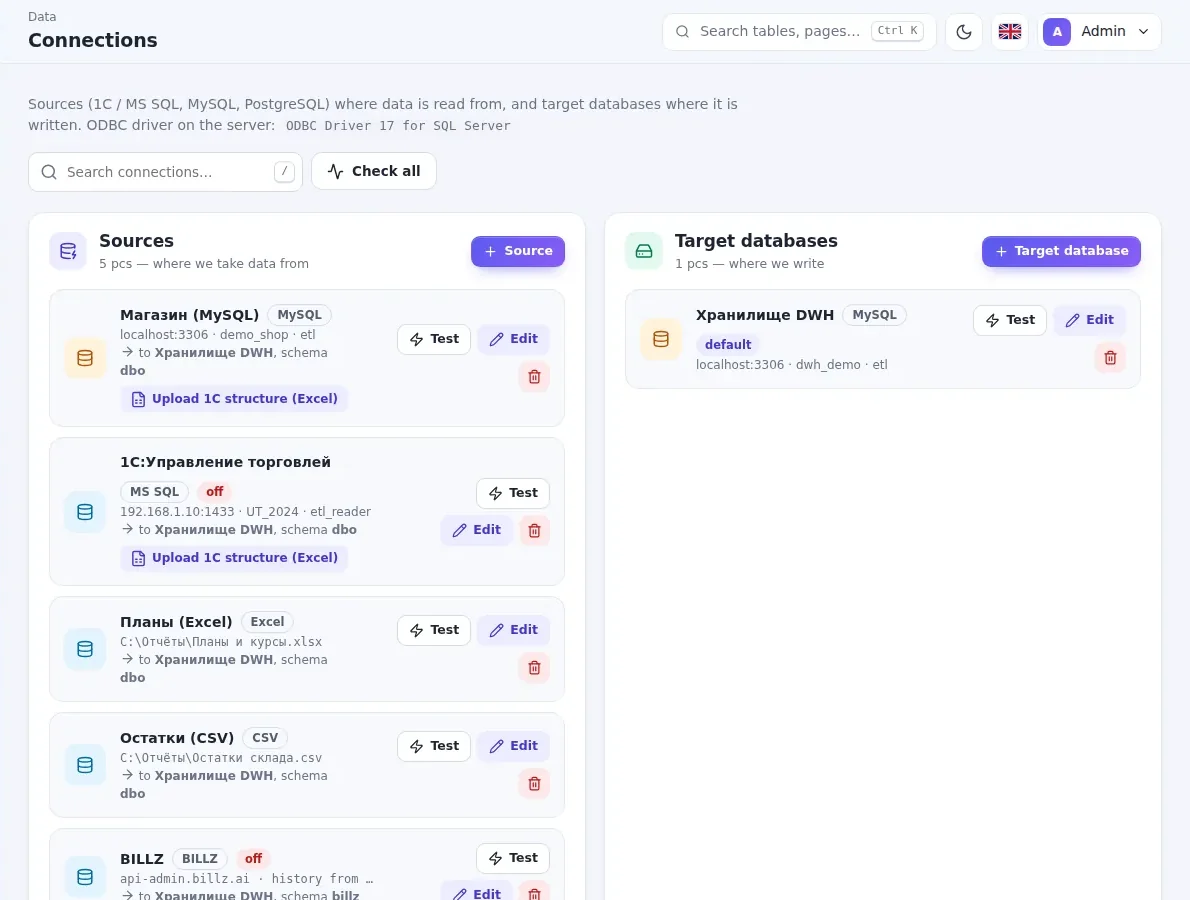
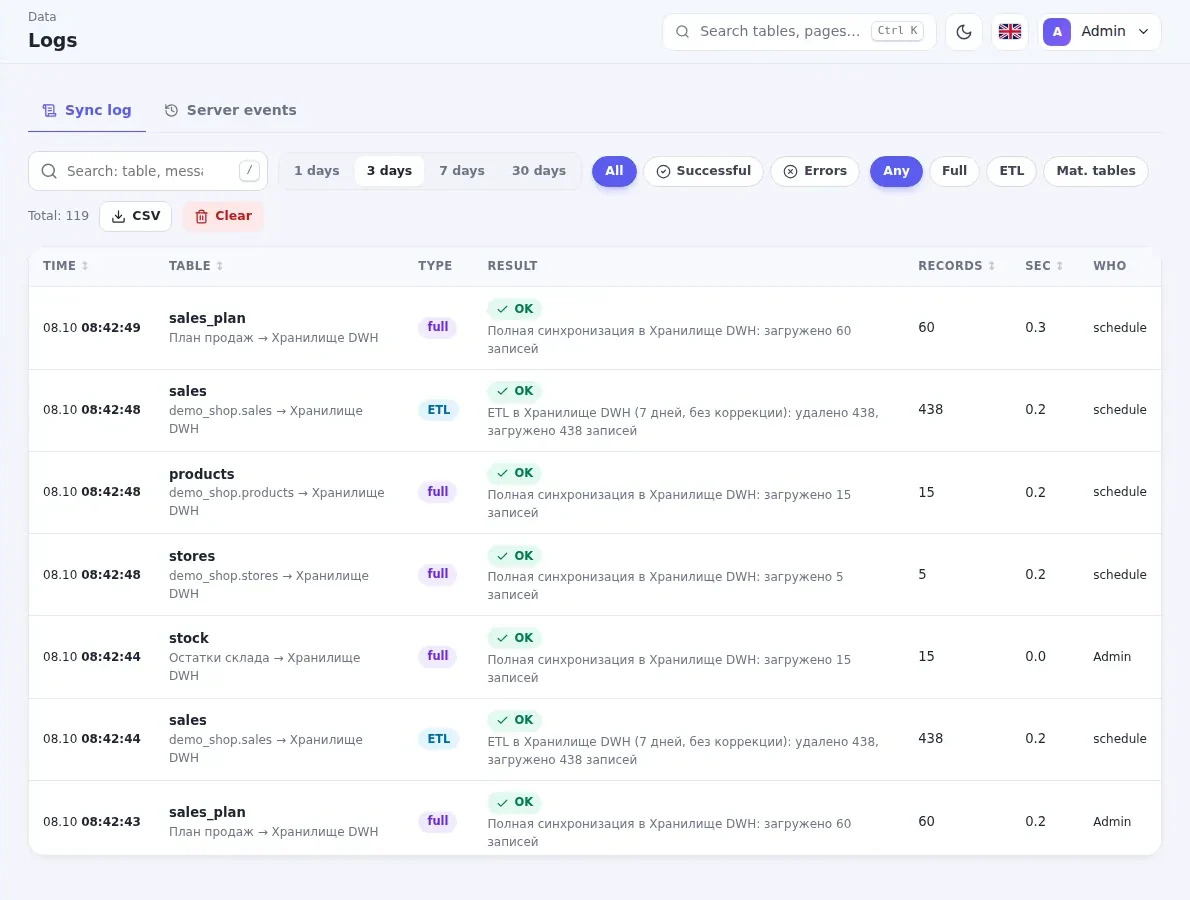
What you get
Any REST API
Websites, marketplaces, payment systems, delivery services, CRMs.
JSON → tables
Nested responses are split into readable columns and tables.
Only what's new
Records since the last date or number — no duplicates.
Keys kept safe
Tokens are stored encrypted, access is read-only.
On schedule
Dropped connection or rate limit — the program waits and retries.
Next to 1C
API data lives in the same database as 1C, ERP and spreadsheets.
You decide where the program and data live
Usually the program is installed on your side — data never leaves the company. Don't want to install anything? We'll run it all on our server.
In your company
- The program on your computer or Windows server
- Warehouse — your MS SQL Server or PostgreSQL
- Data never leaves the company
- Pay only for the key — there is a free plan
On our server
- The panel opens in a browser over HTTPS
- Your own PostgreSQL database — from 10 GB
- Updates and backups are on us
- Monthly billing: key and storage, auto-renew
Frequently asked questions
Which APIs do you work with?
How long does connecting take?
What if the API has rate limits?
Can we do without a developer?
Related articles
How to connect Power BI to 1C: 3 ways and which one to choose
Three ways to get 1C data into Power BI: Excel exports, a direct SQL connection and a separate warehouse. Pros, cons and what to choose.
ReadWhy 1C reports are slow and how to move analytics to a separate database
A yearly sales report takes minutes and accounting complains about freezes? Here are the causes and how to move analytics out of 1C into a separate...
ReadOther solutions
1C → your database with readable names
ETL Sync collects catalogs, documents and registers from the 1C database and writes them to your MS SQL or PostgreSQL database: Catalog.Products...
1С 8.2 / 8.3MS SQLPostgreSQLETL Sync Learn more MS SQL · PostgreSQL · MySQLFrom any database into a new one — fast and on schedule
ETL Sync collects tables from MS SQL Server, PostgreSQL, MySQL and other databases and syncs them into one new database: only changed rows, in...
MS SQLPostgreSQLMySQLMariaDB1С Learn more BILLZ · online ERP · CRMOnline ERP and platforms → your database and web reports
Sales, stock and customers from BILLZ and other online platforms — into your database on schedule. The whole store network in one set of web...
BILLZМойСкладiikoPosteramoCRM Learn more Google Sheets · Excel · CSVGoogle Sheets and Excel — into SQL, by themselves
Sales plans, budgets and reference lists from Google Sheets, Excel and CSV go to MS SQL Server or PostgreSQL on schedule. Column types are...
Google SheetsExcelCSVMS SQLPostgreSQL Learn moreLeave a request
We will call you back within a business day, show the program and help you install it.